AI Agents and enterprise systems work together to create value.
In the AI era, businesses that own the most AI tools may not necessarily win. The real breakthrough belongs to those who know how to reorganize their structure so that Humans, AI, and Systems work seamlessly together.
Below is a fresh perspective on this issue, helping you visualize and grasp the key points.
1. The Trap of "AI Everywhere but Still Stuck"
Looking at the current business landscape, it's easy to see AI appearing everywhere: from customer support chatbots, coding tools for IT professionals, to data analysis software.
However, one reality can be summed up in two words: Disjointed.
- Currently, AI mainly helps individuals work a bit faster.
- But when many individuals come together as a collective, the machinery still operates in the old way.
- The result is that leaders see AI costs rising, but overall company productivity hardly increases.
At this point, AI is no longer just an IT department issue. It has become a matter of survival on the boardroom table.
2. A New Turning Point: Shifting from "Tool" to "AI Colleague" (Agentic Automation)
Previously, you had to type commands for AI to respond to each question (passively), but now technology is shifting towards AI Agents – "AI assistants" capable of automating workflows.
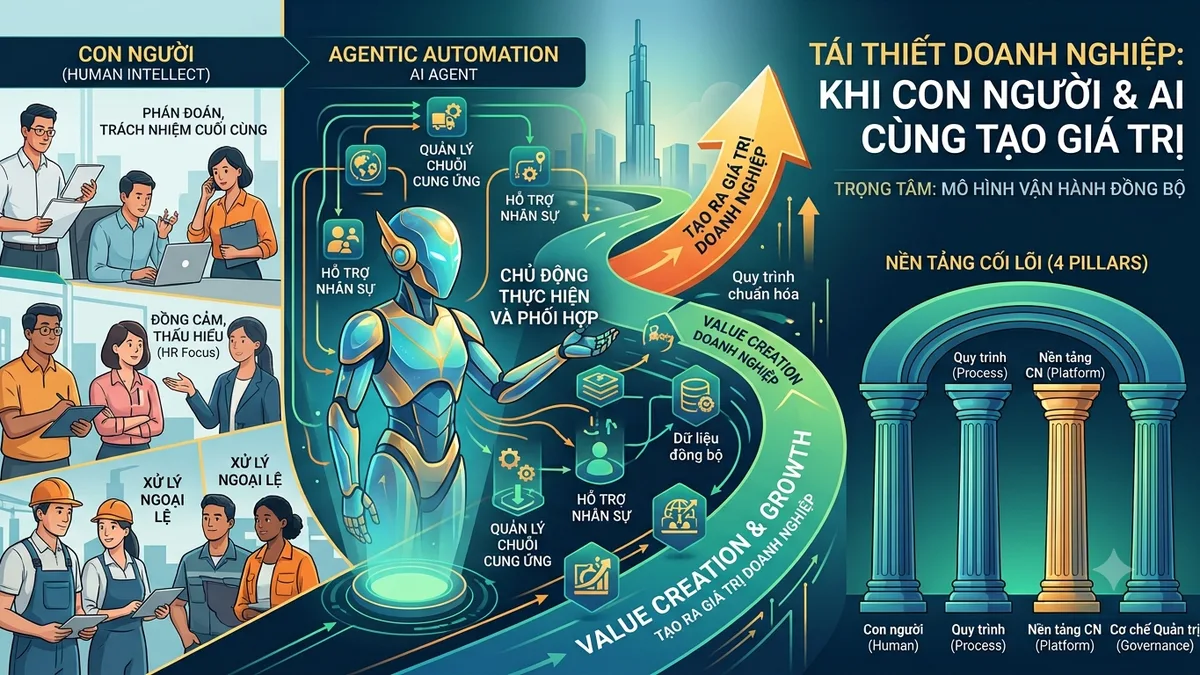
- In factories & Supply Chains: Instead of employees staring at screens monitoring inventory or order progress, AI Agents will automatically handle that 24/7. If they detect a risk of stock shortages, AI will automatically activate a response plan. Humans only appear at the final step: checking and making decisions.
- In Human Resources (HR): AI Agents automatically receive, categorize employee requests, and prepare responses. HR personnel will free up 80% of their paperwork time to focus on tasks that require empathy, understanding, and human connection.
In summary: AI gradually takes on process tasks, while humans rise to a higher level – where judgment, experience, and responsibility are needed.
3. Where is the Bottleneck?
The biggest bottleneck preventing businesses from breaking through is not the lack of intelligent AI, but rather the chaotic internal machinery.
If the workflow processes are unclear, and data is still scattered and tangled, then introducing AI will only make that chaos happen... faster. AI cannot be effective if it operates like an independent add-on application.
For AI to truly bring in money and value, businesses must refresh 4 pillars:
- People: Teach employees how to delegate tasks and work alongside AI.
- Processes: Standardize smooth operational steps, eliminating unnecessary stages.
- Technology: Connect AI directly to the company’s core data systems.
- Management: Clearly define how far AI can go and when human approval is needed.